
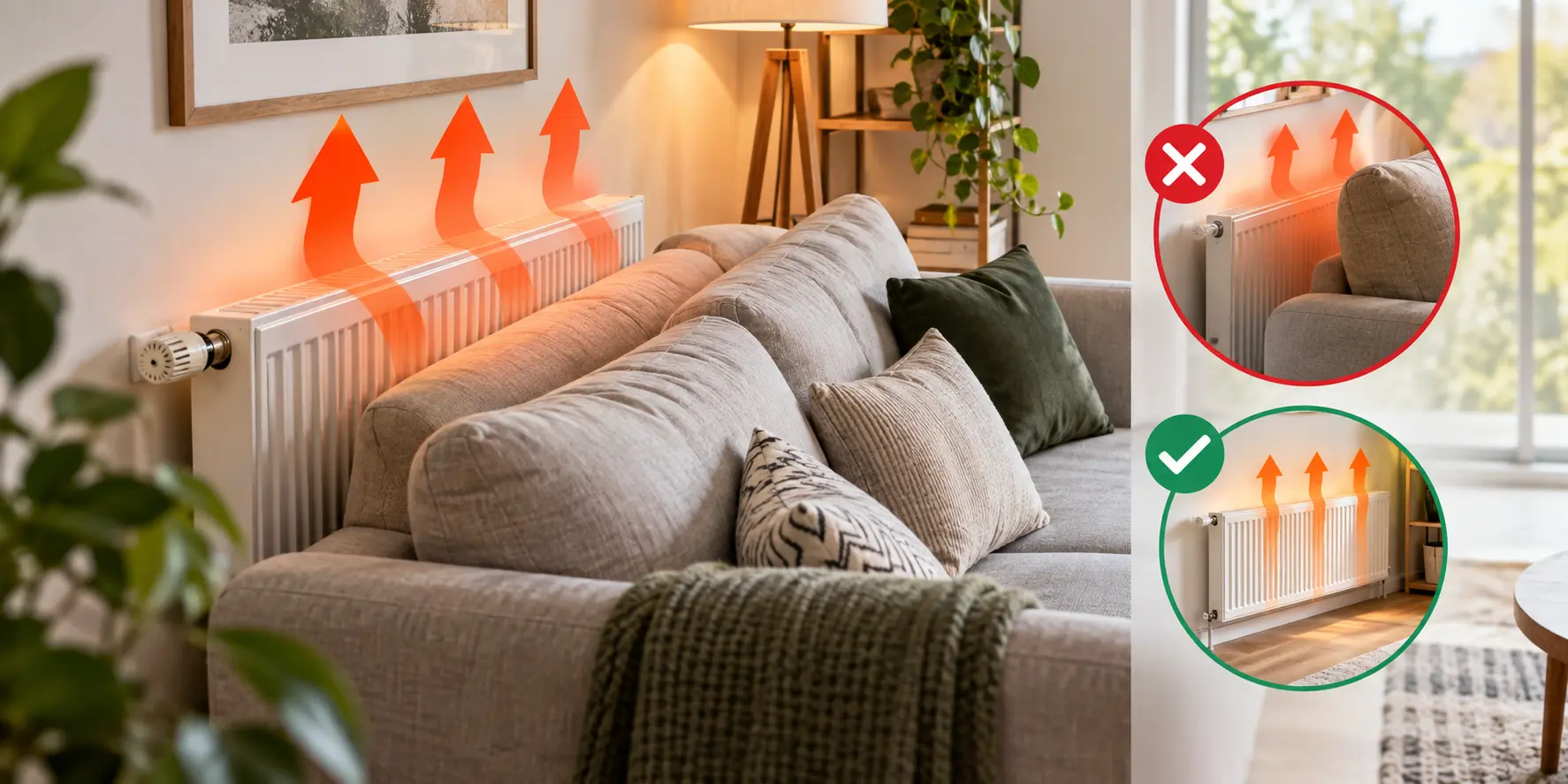
Most living rooms have exactly one wall where the sofa makes sense. It is usually the longest wall, it usually faces the television, and there is usually a radiator on it. So the sofa goes in front of the radiator, everyone gets on with their lives, and a quiet nagging question remains: is this costing me money?
The short answer is yes, a little. The longer answer is that it depends heavily on how close the sofa sits, what it is made of, and whether the back is solid or open. It is a problem with practical fixes that do not involve rearranging the entire room.
How a Radiator Actually Heats a Room
Despite the name, a radiator does most of its work by convection rather than radiation. Cold air is drawn in at the bottom, passes over the hot surfaces, warms up, becomes less dense and rises. That rising air pulls more cold air in behind it, and a circulation current forms that gradually turns over the whole room.
Only around twenty to thirty percent of the output leaves as true radiant heat, the infrared warmth you feel on your skin when standing in front of it.
This matters because the two types of heat are blocked in completely different ways. Radiant heat is stopped by any solid object in the way. Convected heat is only affected if the object physically interrupts the airflow at the top or bottom of the radiator.
What a Sofa Actually Blocks
A sofa in front of a radiator absorbs the radiant portion almost entirely. Upholstery is an excellent insulator, which is precisely why it is comfortable to sit on. That heat does not disappear, it warms the back of the sofa instead, and eventually leaks into the room slowly and inefficiently.
The convected heat is more forgiving. If there is a genuine gap behind the sofa, warm air rises up the back and continues circulating more or less normally. If the sofa is pushed flat against the wall, you have created a chimney with a lid on it, and the warm air gets trapped behind the furniture.
The practical rule. Leave at least 100mm between the back of the sofa and the radiator, and make sure the top of the radiator is not covered. Do those two things and you recover most of the loss. Estimates vary, but a sofa pressed tight against a radiator can waste in the region of twenty percent of its output, while a properly spaced one wastes closer to five.
Not All Furniture Is Equally Bad
| Furniture | Impact | What to do |
|---|---|---|
| Solid back sofa | High | Pull forward 100mm minimum |
| Sofa on legs | Moderate | Air flows underneath, still allow a gap |
| Desk or console table | Low to moderate | Keep the top clear of the radiator |
| Long curtains | Very high | Shorten to sill or tuck behind |
| Radiator cover | Moderate | Choose open fronted and vented top |
Curtains deserve a special mention, because they are by far the worst offender and almost nobody thinks of them as furniture. Floor length curtains hanging in front of a radiator funnel the entire convection current straight up into the cold glass, where it loses its heat to the window and the outside world. This wastes more energy than any sofa.
Five Fixes That Do Not Involve Moving the Sofa
- Pull it forward. Even 100mm makes a measurable difference, and in most rooms nobody notices the sofa has moved.
- Choose furniture on legs. A raised sofa lets air travel underneath and keeps the circulation going.
- Fit reflective foil behind the radiator. This bounces radiant heat back into the room rather than letting it soak into an external wall. Cheap and genuinely effective on solid walls.
- Shorten the curtains to sill length on any window with a radiator beneath it.
- Move the heat instead of the furniture. If the sofa genuinely cannot move, relocating the radiator to a free wall, or adding a vertical radiator elsewhere, solves it permanently.
When to Move the Radiator Instead
Sometimes the layout is simply fixed. In a narrow room, or one with doors and a chimney breast eating the available walls, the sofa has one possible home and it happens to be in front of the heating.
In that situation, moving the radiator is often a better investment than living with the compromise for another decade. It is a smaller job than most people assume, particularly if the new position is on the same wall or an adjacent one. Our guide to moving a radiator before you reconfigure a room covers what is involved and what it typically costs.
The other option is to change the shape of the heat rather than its position. A tall vertical radiator occupies a narrow strip of wall that furniture rarely wants, often beside a door or in a corner, and delivers the same output from a footprint the sofa does not compete for.

Vertical Radiators
Use the narrow wall the sofa does not want, and keep the long wall free.
Browse vertical radiators
Low Level Radiators
Sit below a window or behind a low sofa back without blocking airflow.
See low level optionsIf you are reviewing the whole room rather than just the sofa, our piece on radiator placement mistakes that waste heat covers the other positions that quietly cost you money.
Frequently Asked Questions
Can you put a sofa in front of a radiator?
Yes, provided you leave a gap. Aim for at least 100mm between the back of the sofa and the radiator, and keep the top of the radiator uncovered so warm air can rise freely. A sofa on legs is better than one with a solid base to the floor, because air can also pass underneath.
How much heat does furniture in front of a radiator actually waste?
It depends on the gap. Furniture pressed hard against a radiator can waste roughly twenty percent of its output by absorbing radiant heat and trapping the convection current. With a sensible gap of 100mm or more, that drops to around five percent, which is a negligible difference in practice.
Is a desk in front of a radiator a problem?
Less so than a sofa. Most desks have open sides and a solid top rather than a solid back, so air can still circulate around the radiator. The thing to avoid is a desk with a modesty panel that seals the gap, or storage pushed underneath that blocks the space directly in front of the radiator.
Does foil behind a radiator really work?
On an external solid wall, yes, noticeably. Reflective foil sends radiant heat back into the room instead of letting it warm the masonry. On a well insulated cavity wall or an internal wall the benefit is much smaller, because far less heat is being lost through the wall in the first place.
The Short Version
You do not need to redesign your living room. Pull the sofa forward a hand's width, keep the top of the radiator clear, shorten any curtains that hang over it, and you have recovered most of what you were losing. If the layout genuinely will not allow it, moving the radiator or switching to a vertical design solves it for good.
Browse the full designer radiator collection if you are rethinking the room, or call 01204 695387 to talk through the layout.
0 Comment(s)