
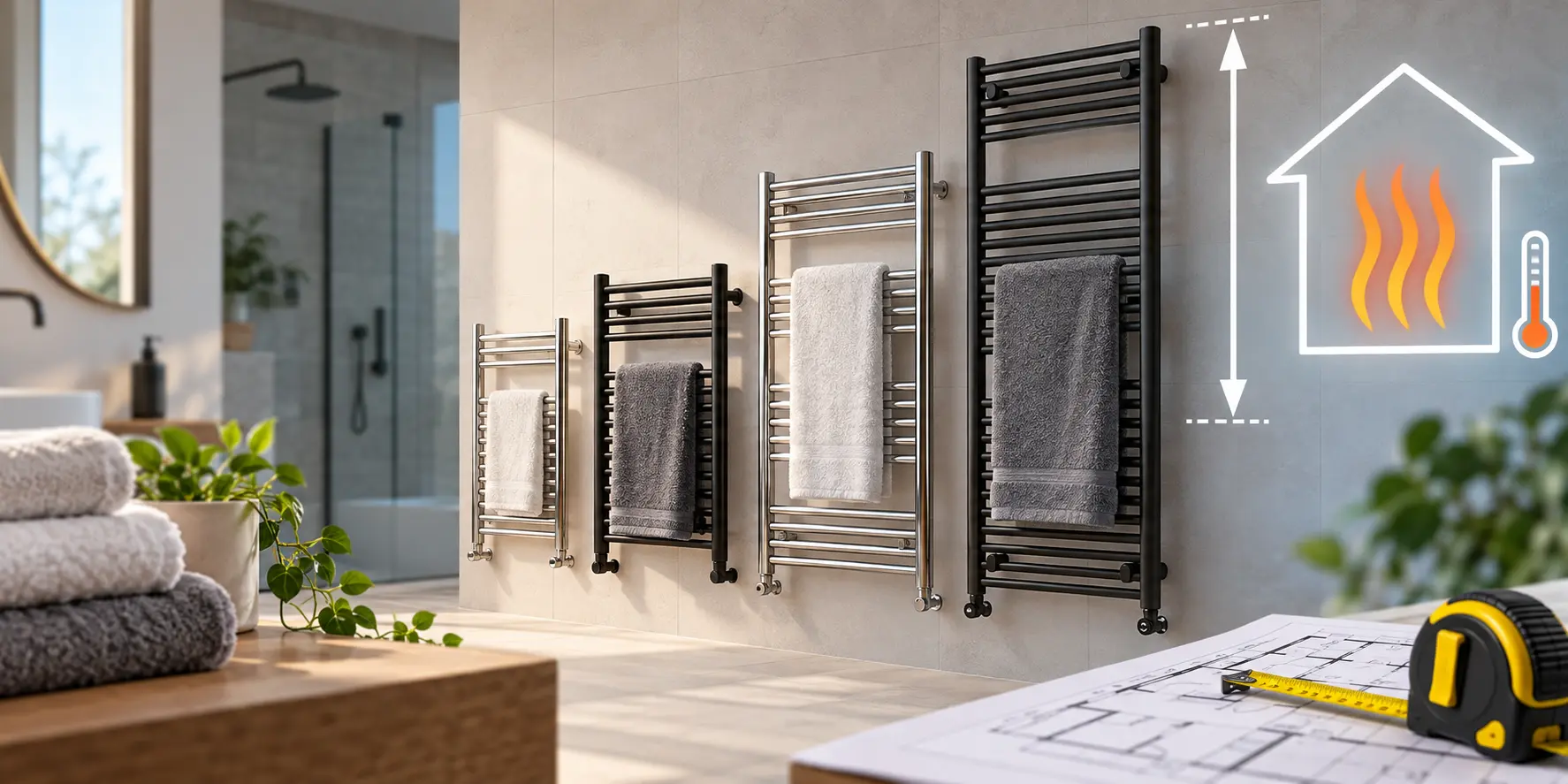
Bathrooms are the room people most often get wrong when sizing heating, and it happens for an understandable reason. A bathroom is usually the smallest room in the house, so it seems logical that it needs the least heat. In practice it is frequently the hardest room to warm, and a towel rail chosen on looks alone will leave it cold.
This guide walks through how to work out the heat output you actually need, and how that translates into a towel rail size you can buy.
Why Bathrooms Need More Heat Than You Think
Three things conspire against a bathroom. It has hard, cold surfaces everywhere, tiles and porcelain and glass, all of which absorb heat rather than reflect it. It is full of moisture, and evaporating water actively cools the air. And it usually has an extractor fan deliberately pulling warm air out of the room.
On top of that, comfort expectations are different. You want a living room at around 21 degrees. You want a bathroom closer to 22 or 23, because you are standing in it wet and largely undressed.
The standard BTU rule of thumb for living spaces underestimates bathrooms badly. Most sizing guides recommend adding ten to fifteen percent to whatever a general calculation gives you.
Working Out Your BTU Target
Start by measuring the room in metres, length by width by height, to get the volume. Then apply a multiplier based on the room type. For bathrooms, roughly 170 to 200 BTUs per cubic metre is a reasonable working range, rising towards the top of that if the room has an external wall, a large window, or is above an unheated space like a garage.
| Bathroom type | Typical size | BTU needed | Suggested rail width |
|---|---|---|---|
| Cloakroom | 1.5m x 1m | 700 to 1,000 | 300mm |
| En suite | 2m x 1.5m | 1,200 to 1,600 | 400mm to 450mm |
| Family bathroom | 2.5m x 2m | 2,000 to 2,600 | 500mm to 600mm |
| Large bathroom | 3.5m x 2.5m | 3,200 to 4,000 | 750mm, or rail plus radiator |
If you would rather not do the arithmetic, our heat output calculator will do it properly, factoring in glazing and wall construction.
The Towel Problem Nobody Mentions
Here is the detail that catches people out. A towel rail's quoted BTU figure assumes it is hanging there uncovered. Drape two thick bath towels across it and you have insulated a large part of the heated surface. Real world output can drop by thirty to forty percent.
If the towel rail is the only heat source in the bathroom, size it for your BTU target and then add roughly a third on top to allow for towels. If the room also has a radiator, you can size the rail purely for drying towels and let the radiator heat the space.
Width, Height and How They Interact
Width is usually fixed by the wall
Most people have a specific gap to fill, commonly between a door and a basin, or above a radiator recess. Standard widths run 300mm, 400mm, 450mm, 500mm, 600mm and 750mm. Choose the widest that comfortably fits with a little clearance either side.
Height is where you find the output
Once width is fixed, height does the heavy lifting. A 500mm wide rail at 800mm tall might give you 1,200 BTUs. The same width at 1400mm tall can push past 2,000. If your calculation says you need more heat than the width allows, go taller before going wider.
Bar spacing matters for drying
Closely spaced bars give more heated surface and therefore more output. Widely spaced bars are easier to hang thick towels over and dry them faster, because air can circulate. If drying is your priority rather than heating the room, slightly wider spacing is the better choice.


When One Towel Rail Is Not Enough
In larger bathrooms, and particularly in older properties with solid walls and single glazing, a towel rail alone will struggle no matter how tall you go. The answer is to treat the rail as a towel dryer and add a separate radiator for the room heat, or to choose a rail designed for high output rather than a slim ladder style.
It is also worth checking where the heat is going before you buy anything bigger. Our guide to home heat loss and how to stop it covers the quick wins that often make a smaller rail perfectly adequate.
Where to Put It
Sizing is only half the job. A correctly sized rail in the wrong place still underperforms, and bathrooms offer fewer good positions than most rooms.
The traditional advice is to put heating under a window, where cold air falls and the rising warm air forms a barrier against the draught. That still holds in a bathroom with a reasonable sized window. Where bathrooms differ is that the window is often small, high up and frosted, and the wall beneath it is occupied by a bath or a cistern.
If you cannot use the window wall, the next best position is the wall you face when stepping out of the shower or bath, within easy reach so you are not crossing a cold room dripping to fetch a towel. Avoid the wall directly behind a door that opens flat against it, and avoid boxing a rail into a tight alcove where air cannot circulate around the bars.
Leave at least 100mm of clear space above and below the rail, and roughly 50mm from any side wall. Those gaps are what let convection currents form. Our guide to radiator placement mistakes that waste heat goes into the airflow principles in more detail, and they apply just as much to a towel rail as a panel radiator.
Electric, Plumbed or Both
A plumbed rail runs off your central heating and costs nothing extra to heat while the boiler is on, but it is cold all summer. A fully electric rail works year round and needs no pipework, which makes it the obvious answer for a bathroom with no convenient heating circuit nearby.
Dual fuel gives you both, a plumbed rail with an electric element fitted, so it runs from the heating in winter and from electricity in summer. If you are planning a refit rather than a straight swap, it is worth deciding this before the pipework is finalised, because retrofitting a connection afterwards is considerably more disruptive than allowing for it at first fix.
Frequently Asked Questions
What size towel rail do I need for a small bathroom?
For a typical en suite of around 2m by 1.5m, look for roughly 1,200 to 1,600 BTUs, which usually means a rail 400mm to 450mm wide and somewhere between 800mm and 1200mm tall. If the rail is the only heat source, aim for the upper end of that range to allow for towels covering the bars.
Can a towel rail heat a whole bathroom on its own?
In a small or well insulated bathroom, yes, provided you size it correctly and add capacity for towels. In a larger bathroom, one above a cold space, or a period property with solid walls, a towel rail on its own will usually fall short and you will want a separate radiator as well.
Should I choose a wider or a taller towel rail?
Taller, in most cases. Width is normally dictated by the wall space you have, while height is the variable you can increase freely. A taller rail at the same width gives significantly more heat output and more hanging space for towels, without eating into the room.
What is a good BTU per square metre for a bathroom?
Work in cubic metres rather than square, because ceiling height matters. Around 170 to 200 BTUs per cubic metre is a sound starting point for a UK bathroom, towards the higher figure if the room has an external wall, large window or poor insulation.
Choosing With Confidence
Measure the room, calculate your target, add a margin for towels, then pick the tallest rail that fits your available width. Get those four steps right and the room will be warm and the towels dry.
Browse the full heated towel rail range by size and output, or explore electric towel rails if the bathroom has no convenient pipework. Any doubts about sizing, call 01204 695387.
0 Comment(s)