
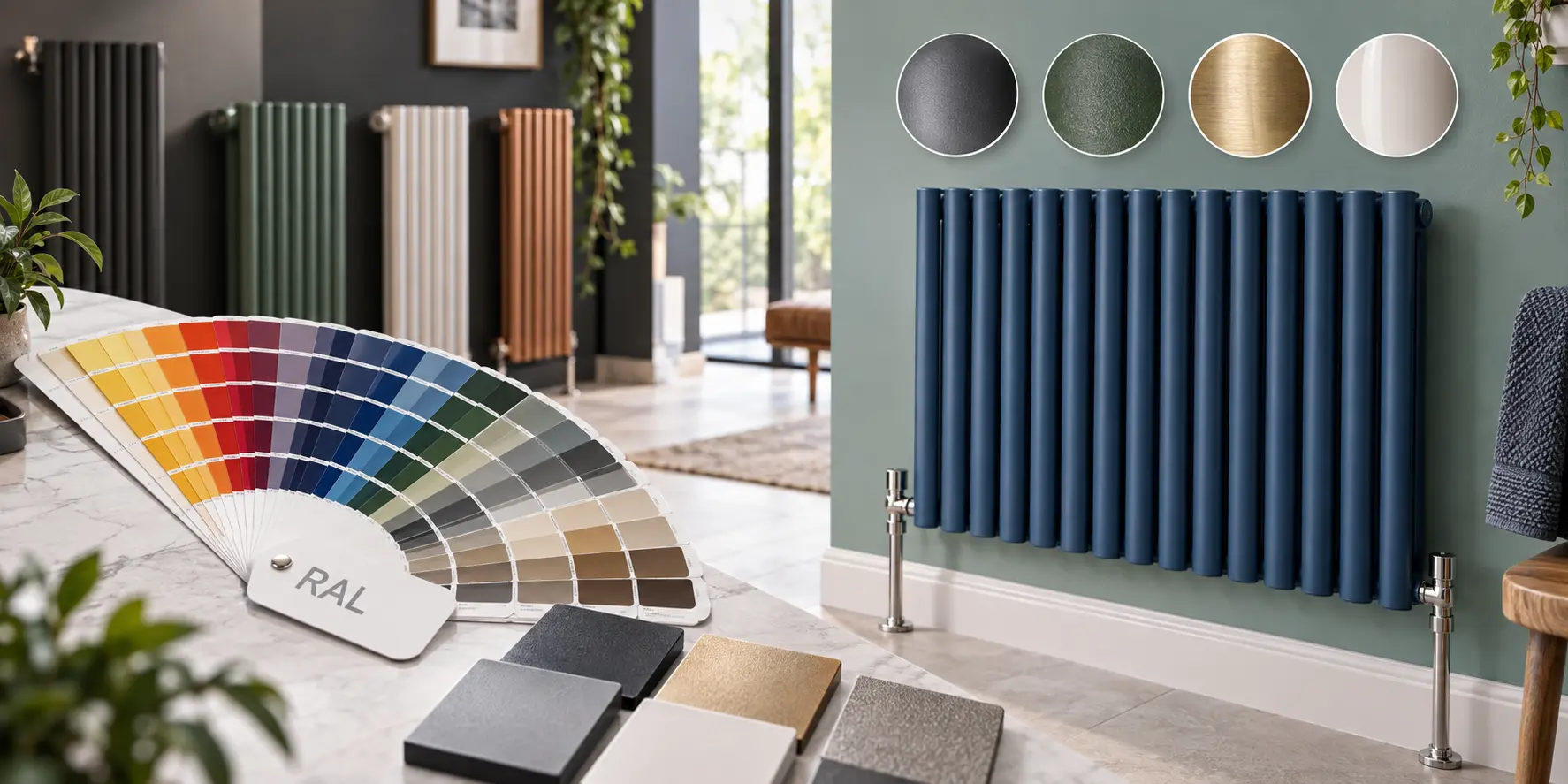
For most of the last century, radiators came in one colour. White, whether you liked it or not, tucked under a window and hopefully ignored. That has changed completely. A radiator is now something people choose the way they choose a kitchen worktop or a set of door handles, and the colour is usually the decision that takes longest.
It is also the decision people most often put off, because a radiator is not something you can repaint on a Sunday afternoon if you get it wrong. This guide should make the choice feel less final and more obvious.
Understanding RAL, the Colour System Behind Everything
Almost every bespoke radiator finish refers to a RAL number. RAL is a European colour standard, originally German, that assigns a four digit code to a precise shade. RAL 9005 is jet black. RAL 6005 is British racing green. RAL 7015 is slate grey.
The value of a standardised code is that it removes ambiguity. One manufacturer's idea of anthracite can be noticeably different from another's, but RAL 7016 is RAL 7016 wherever it is made. If you are matching a radiator to existing window frames, kitchen cabinetry or a bi fold door, ask for the RAL reference and you can match it exactly.
Worth knowing. Aluminium window and door frames in UK homes are very commonly RAL 7016 anthracite grey. If you want a radiator that reads as part of the architecture rather than a separate object, matching that reference is an easy win.
Finish Matters as Much as Colour
Two radiators in identical RAL shades can look completely different depending on the finish applied. This catches people out more than the colour itself.
Gloss
Reflective and traditional. Gloss bounces light around, which helps in darker rooms, and it suits period column radiators where a slight sheen reads as authentic. It does show dust and fingerprints more readily.
Smooth matt
Flat, contemporary and quietly confident. Smooth matt absorbs light rather than reflecting it, which makes a large radiator feel less imposing. It is the finish of choice for modern interiors and it hides marks well.
Textured matt
A very fine grain across the surface. Textured finishes are the most forgiving of all, disguising both fingerprints and the minor imperfections that any painted metal surface will eventually pick up. They also feel more tactile, which matters for a column radiator people brush past daily.
Metallic and hammered
Copper, silver and gun metal finishes sit in their own category. A hammered finish has a dimpled texture that catches light unevenly, giving depth that a flat colour cannot. These read as decorative objects rather than heating.
Choosing a Colour That Works With the Room
There are really only three strategies, and it helps to decide which one you are pursuing before you start browsing.
- Disappear. Match the radiator to the wall colour as closely as possible. The radiator becomes architecture rather than furniture. Best in small rooms, hallways and anywhere the radiator is large relative to the space.
- Blend. Pick a shade a step or two darker or lighter than the wall, in the same family. The radiator is visible but calm. This is the safest option and works almost everywhere.
- Contrast. Choose a colour that deliberately stands against the wall. A dark radiator on a pale wall, or a copper finish on deep green. Best in rooms with a clear focal point already, and in period properties where the radiator is genuinely handsome.
| Interior style | Colour family | Suggested finish |
|---|---|---|
| Period and Victorian | Cream, sand, dark green | Gloss or textured matt |
| Modern minimal | White, light grey | Smooth matt |
| Industrial | Gun metal, raw metal, black | Textured matt or lacquered |
| Warm and traditional | Chocolate, tobacco, copper | Hammered or textured |
| Coastal and calm | Dark blue, sage, beige | Smooth matt |
The Colours People Actually Choose
Anthracite and dark grey remain the most requested finishes, largely because they coordinate with the aluminium windows and bi fold doors fitted in so many UK renovations. Gun metal grey has grown quickly, offering a slightly warmer, more metallic alternative to flat anthracite.
At the other end, cream and beige shades have made a strong return in period properties, where brilliant white can look harsh against original plasterwork and timber. Deep blues and racing greens remain the choice for people who want the radiator to be a feature.


Hammered Copper
A decorative finish with texture that changes as the light moves.
See copper and silver
Raw Metal Lacquered
Unpainted steel under clear lacquer, for an honest industrial look.
See raw metalPractical Points Before You Commit
Bespoke finishes are made to order, which has two consequences. Lead times are longer than stock items, typically a few weeks rather than a few days, so order well ahead of a decorating deadline. And custom colours are generally non returnable, because nobody else is waiting for a radiator in your exact shade.
Order a sample if you can, and look at it in the actual room at different times of day. Colours shift dramatically between morning daylight and evening lamplight, and grey in particular can read blue, green or brown depending on what is around it.
Finally, think about the valves at the same time rather than afterwards. They are the one part you touch, and a mismatched valve finish undoes a lot of careful colour work. Our guide to radiator valve finishes covers which pairings work.
Frequently Asked Questions
Can I get a radiator in any RAL colour?
On bespoke and made to order ranges, generally yes. Our column radiators can be finished in the full RAL range, so if you can supply the reference, it can usually be matched. Stock ranges are limited to the finishes held, which is why bespoke is the route for an exact match to existing joinery or frames.
Does the colour of a radiator affect its heat output?
Only marginally. Darker surfaces radiate very slightly more efficiently than pale ones, but the difference in a domestic setting is a fraction of a percent and nowhere near enough to influence your choice. Size, material and column count matter enormously. Colour effectively does not.
What is the difference between smooth matt and textured matt?
Smooth matt is completely flat to the touch with no sheen. Textured matt has a fine grain across the surface, which catches light subtly and hides fingerprints and minor marks far better. Textured is the more practical choice in busy family spaces and hallways.
How long does a bespoke coloured radiator take to arrive?
Made to order radiators in custom colours typically take a few weeks rather than the few days you would expect from stock. If your radiator is part of a wider renovation, order it early in the project rather than at the end, so decorating and plumbing are not held up waiting for it.
Making the Choice
Decide first whether you want the radiator to disappear, blend or stand out. Pick the finish before the exact shade. Match a RAL reference if something in the room already sets the tone. Then order early and choose valves at the same time.
Explore the full made to order column radiator range to see the colour families available, or call 01204 695387 if you have a RAL reference you want matched.
0 Comment(s)