
Here is a scenario every household recognises. It is late May, the heating has been off for three weeks, and the bathroom towels have taken on that faintly damp, never quite dry quality. The towel rail is right there on the wall, completely cold, because it is plumbed into a central heating system that has sensibly switched itself off for the summer.
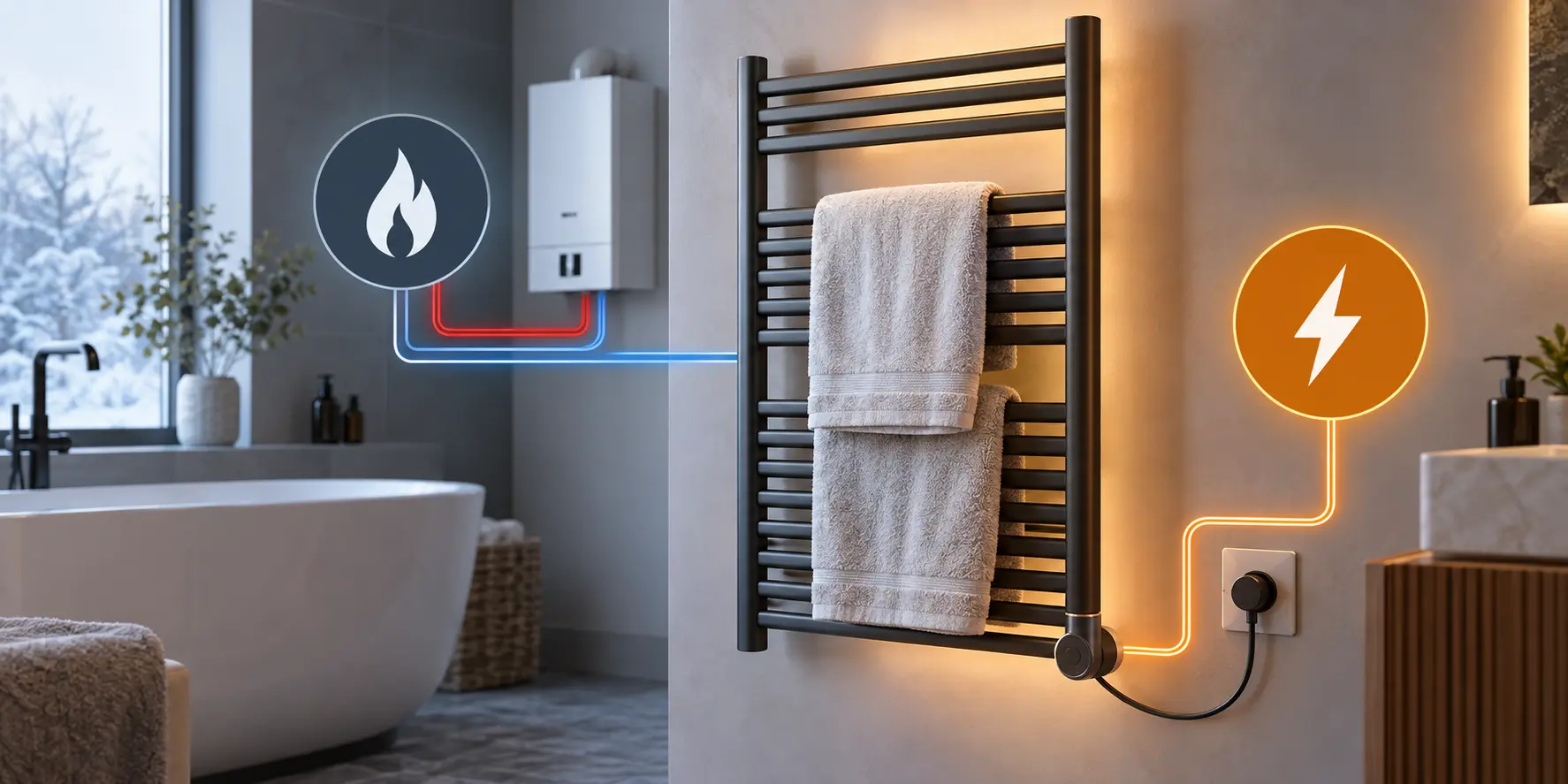
Dual fuel solves exactly this. It lets a towel rail run from your central heating in winter and from an electric element the rest of the year, so you get warm, dry towels in August without firing up the boiler for the whole house.
What Dual Fuel Actually Means
A standard heated towel rail is filled with water and connected to your central heating circuit at two points, a flow and a return. When the heating runs, hot water circulates through it. When the heating is off, so is the rail.
A dual fuel conversion keeps that water connection but adds a second heat source inside the rail itself. An electric heating element is fitted into the bottom of the rail and heats the water already sitting in it, independently of the boiler. The rail stays plumbed in, so in winter it still works as part of your heating system exactly as before.
You end up with one towel rail and two ways to heat it, which is far more useful than it sounds on paper.
The Three Parts You Need
Converting a standard rail is more straightforward than most people expect. There are three components.
| Component | What it does | Why it matters |
|---|---|---|
| Heating element | Heats the water inside the rail electrically | Wattage must match rail size |
| T piece connector | Splits one connection into two | Lets valve and element share an inlet |
| Radiator valves | Connects the rail to the heating circuit | Finish should match the element cap |
The T piece is the bit people forget. A towel rail only has two bottom connections, and on a dual fuel setup one of those has to accommodate both a valve and the element. The T piece splits that single entry point so both can sit on the same side without looking like an afterthought.

Geyser SMART Thermostatic Element
App and thermostat control, with timers and a boost function for the school run.
See the SMART element
Chrome T Piece Connector
The part that makes the conversion possible, and the one most people miss.
View the T pieceChoosing the Right Element Wattage
Undersize the element and the rail will feel lukewarm. Oversize it and you risk the water expanding more than the rail was designed for. The sizing rule is simple: match the element wattage to roughly the heat output of the rail itself in watts, then round down rather than up.
- Small rails, around 300mm to 400mm wide, usually suit a 200W element.
- Mid size rails, 500mm to 600mm wide, typically want 300W to 600W.
- Large or tall rails, 750mm wide or over 1400mm high, often need 900W.
One important detail on dual fuel. The rail must never be completely full of water when an element is fitted. Water expands as it heats, and it needs somewhere to go. An installer will leave an air gap of roughly ten to fifteen percent at the top. This is not optional and it is the main reason dual fuel conversions are a job for a qualified fitter.
Thermostatic, Timed or Simple?
Fixed heat elements
The most affordable option. They heat to a set temperature and stay there until switched off. Fine if you are happy to turn the rail on and off by hand, and perfectly adequate for a guest bathroom that sees occasional use.
Thermostatic elements
These let you set a target temperature and hold it, which uses less electricity than running flat out. Most include several preset modes and a child lock. This is the sensible default for a main bathroom.
Smart and programmable elements
The step up adds weekly scheduling and app control, so the rail can come on for an hour before everyone gets up and again in the evening, then stay off the rest of the day. Over a summer, that scheduling is where the real saving lives. Browse the full range of thermostatic heating elements to compare wattages and control types.
What It Costs to Run
A 300W element running for two hours a day uses 0.6kWh. At roughly 25p per kWh that is about 15p a day, or under five pounds a month, for warm towels every morning through the summer. Compare that with firing the boiler to heat an entire house of radiators for the sake of one room, and the maths makes itself.
Thermostatic elements cut that further, because once the rail reaches temperature it only draws power intermittently to hold it there rather than running continuously.
Dual Fuel or Fully Electric?
If you are starting from scratch rather than converting an existing rail, there is a third option worth weighing up. A fully electric towel rail is filled and sealed at the factory and never connects to your heating system at all. It needs a power supply and nothing else.
Fully electric makes sense in a few specific situations. If the bathroom has no existing pipework and running new pipes means lifting floors, the electrical route is dramatically cheaper. It also suits loft conversions, garden rooms and annexes that sit outside the main heating circuit, and flats where the heating is communal and you have no control over when it runs.
Dual fuel wins everywhere else. Through the winter the rail costs you nothing extra to run, because it is heated by a boiler that is already on for the rest of the house. You only pay for electricity in the months when the heating is off. A fully electric rail, by contrast, draws power every single time it heats, all year round.
There is a resale consideration too. A plumbed rail with a dual fuel element reads as a properly specified bathroom, while a fully electric rail on an otherwise wet system can look like a shortcut taken during a refit.
A Note on Valves and Finish
One small thing that makes a surprising difference to the finished look. Your element will have a visible control cap at the bottom of the rail, and your valves sit alongside it. If the element cap is white and the valves are chrome, the eye notices immediately.
Elements are commonly available in chrome, white, black and anthracite. Pick the one that matches both your rail and your valve set, and the conversion disappears into the design rather than announcing itself. If you are choosing valves at the same time, our guide to angled, corner and straight valves covers which shape suits your pipe layout.
Frequently Asked Questions
Can any heated towel rail be converted to dual fuel?
Most standard water filled towel rails can, provided they have a suitable bottom connection for an element. Rails that are already sealed electric only units cannot, because they are filled and sealed at the factory. If you are unsure about a specific rail, check the product specification or ask before ordering an element.
Do I need an electrician to fit a dual fuel element?
Yes. Bathrooms are governed by electrical zoning regulations in the UK, and any new fixed electrical connection in a bathroom is notifiable work. A plumber can usually handle the element and T piece installation, but the electrical supply and connection should be done or signed off by a qualified electrician.
Will the towel rail work on both heat sources at the same time?
It should not, and you should avoid running both together. In winter you close the electric element down and let the central heating do the work. In summer you close the valves and run the element. Running both risks overheating the water and over pressurising the rail.
Does dual fuel work with a heat pump system?
It works particularly well. Heat pumps run at lower flow temperatures, so towel rails on a heat pump system can feel disappointingly cool. An electric element lets you top the rail up to a genuinely warm temperature when you want dry towels, without raising the flow temperature for the whole house.
Putting It Together
Dual fuel is one of those upgrades that costs relatively little and gets noticed every single day for half the year. Pick a rail you like, match an element to its output, add a T piece and a set of valves in the same finish, and you have a bathroom that works in August as well as it does in January.
Start with the heated towel rail collection, then browse elements and timers to complete the conversion. If you would rather talk it through, call 01204 695387 and we will help you match the parts.
0 Comment(s)