
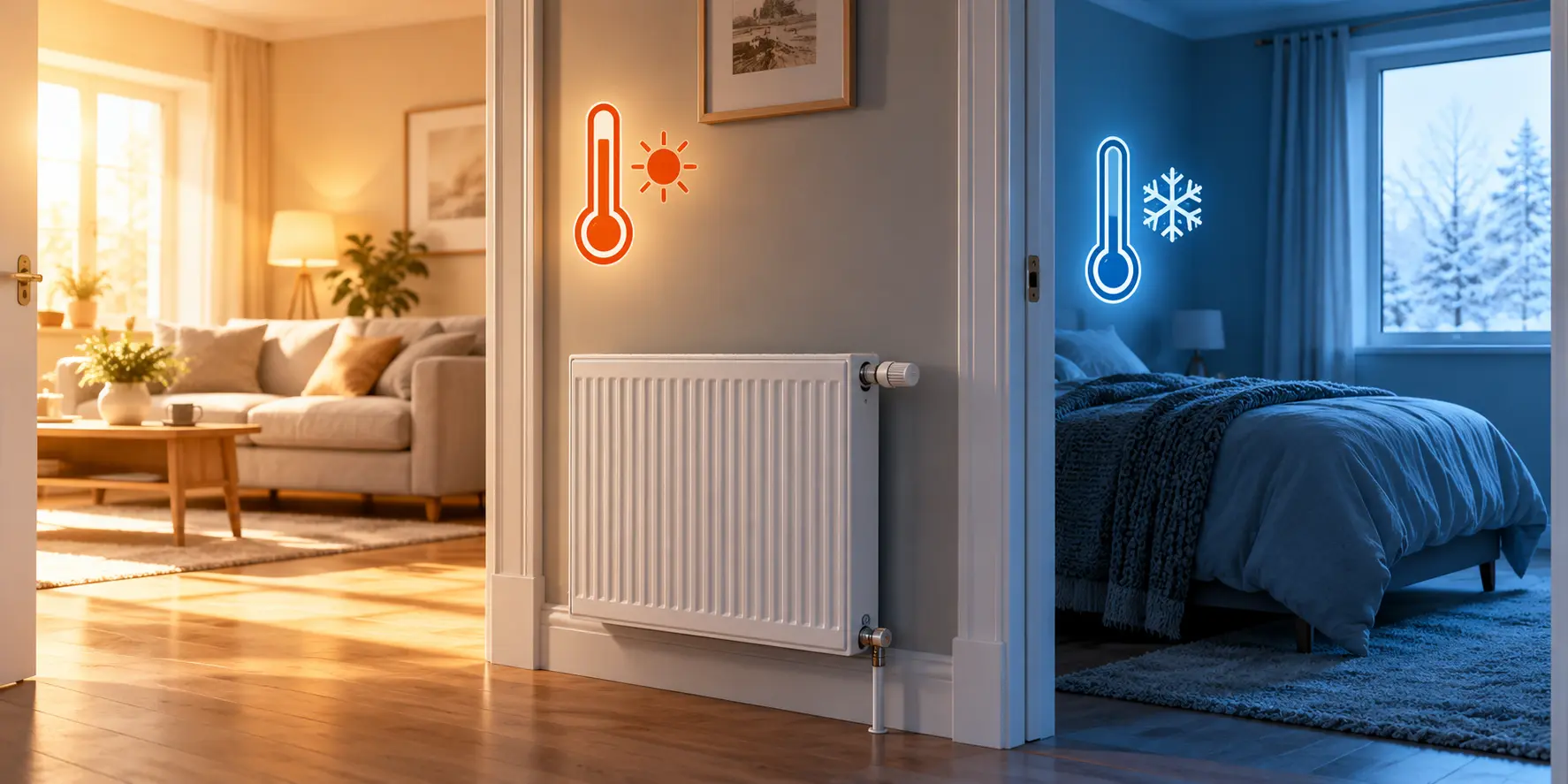
Every house seems to have one. The back bedroom that needs an extra blanket. The dining room nobody uses in January. The office above the garage where you work with a hot water bottle on your lap. The rest of the house is perfectly comfortable, and yet this one room refuses to join in.
The good news is that it is almost never a mystery. There are about six realistic causes, they can be worked through in order, and most of them cost very little to fix.
Start With the Radiator Itself
Is it cold at the top and warm at the bottom?
That is trapped air, and it is the most common cause by a distance. Air rises to the top of the radiator and stops hot water filling that section, so you lose a third or more of the surface area. Bleeding the radiator takes two minutes with a bleed key and a cloth.
If you have not done it before, our step by step on balancing and bleeding your system covers the process safely.
Is it warm at the top and cold at the bottom?
That is the opposite problem and a more serious one. Sludge, which is corrosion debris suspended in the system water, settles in the bottom of radiators and blocks circulation. A single sludged radiator can sometimes be flushed on its own. A system full of them needs a power flush and an inhibitor added afterwards.
Is the whole radiator stone cold?
Check the valves first. A thermostatic valve that has been closed all summer can seize with the pin stuck down. Take the head off and press the pin in the centre. If it does not spring back, it is stuck, and freeing it with a gentle tap or a pair of pliers often restores the radiator instantly.
Then Look at the System
If the radiator itself checks out, the problem is usually distribution. Central heating is lazy. Hot water takes the path of least resistance, which means radiators closest to the boiler fill first and fastest, while the furthest radiator gets whatever is left.
This is what balancing fixes. You deliberately restrict the lockshield valves on the radiators nearest the boiler, forcing more flow towards the far end of the circuit. It is fiddly but free, and it transforms a system where one room never gets its share.
A quick diagnostic. Turn the heating on from cold and walk round the house touching each radiator every five minutes. Note the order they warm up in. If your cold room is last by a wide margin, the system needs balancing rather than a new radiator.
The Radiator Might Simply Be Too Small
This is the cause people overlook, because the radiator was presumably right when it was installed. Rooms change. A conservatory gets added, a chimney gets blocked up, a small bedroom becomes a home office with a desk against an outside wall, or an extension leaves a previously internal wall exposed to the weather.
It is also depressingly common for developers to fit the cheapest radiator that meets minimum standards, which leaves nothing in reserve for a cold February.
| Symptom | Likely cause | Typical fix |
|---|---|---|
| Cold top, warm bottom | Trapped air | Bleed the radiator |
| Warm top, cold bottom | Sludge build up | Flush and add inhibitor |
| Completely cold | Seized valve pin | Free the pin or fit a new head |
| Last to warm up | System out of balance | Adjust lockshield valves |
| Warm but never enough | Undersized radiator | Increase output |
To check whether size is the issue, work out what the room actually needs using our BTU calculator and compare it against the output of what is on the wall. If the gap is more than around fifteen percent, no amount of balancing will close it.
Where the Heat Is Escaping
Sometimes the heating is doing its job and the room is simply losing warmth faster than it gains it. Rooms that sit above garages, over passageways, in extensions, or with three external walls are working against physics.
- Check the loft insulation above the room. Coverage is often patchy at the edges and thin over the corners of a house.
- Feel around the window frames on a windy day. Old seals leak more than people expect.
- Look at the floor if the room is above an unheated space. Suspended floors over garages are a classic cold spot.
- Check for a blocked or open chimney. An unused open flue pulls warm air straight out of the room.
Our beginner's guide to home heat loss works through how to find and seal these properly.
When Upgrading Is the Right Answer
If you have bled, balanced, checked the valves and improved the insulation, and the room is still cold, you need more heat into it. The usual constraint is that there is nowhere obvious to put a bigger radiator.
You have more options than you might think. A vertical radiator uses wall height rather than length, so a tall slim unit can replace a short panel and roughly double the output. A multi column radiator adds depth rather than width, gaining surface area without taking more wall. An aluminium radiator delivers more heat per centimetre than steel in the same footprint.

Go Vertical
Use wall height instead of length when floor level space has run out.
Browse vertical radiators
Increase Output
Aluminium and multi column designs give more heat from the same wall.
See high output optionsFrequently Asked Questions
Why is one radiator not heating up when the others are fine?
The three usual causes are trapped air, a seized thermostatic valve, or an unbalanced system starving the furthest radiator of flow. Work through them in that order. Bleed it first, then check the valve pin moves freely, then look at balancing. All three are things a confident homeowner can tackle without a plumber.
Why is the radiator furthest from the boiler always coldest?
Because hot water follows the easiest route, and the nearest radiators offer less resistance. Balancing corrects this by partially closing the lockshield valves on the closest radiators, which pushes more flow along the circuit to the far end. It costs nothing but patience and usually fixes the problem entirely.
Can a room be cold even with a working radiator?
Absolutely. If the radiator is undersized for the room, or the room loses heat unusually fast, the radiator can be running perfectly and still never get ahead. Rooms above garages, in extensions, or with several external walls commonly need more output than the original specification allowed for.
Should I turn other radiators down to heat one cold room?
As a temporary diagnostic it is useful, and if turning others down makes the cold room warm, you have confirmed a balancing problem. As a permanent fix it is a poor solution, because you are making other rooms uncomfortable. Balance the system properly instead, or increase the output in the room that needs it.
Working Through It
Bleed, check the valve, balance, look for heat loss, then consider output. Nine cold rooms out of ten are solved before you reach the last step, and the tenth needs a radiator that suits the room as it is today rather than as it was when the house was built.
If you get to that point, call 01204 695387 with the room dimensions and what is currently on the wall, and we will work out what will actually fix it.
0 Comment(s)