
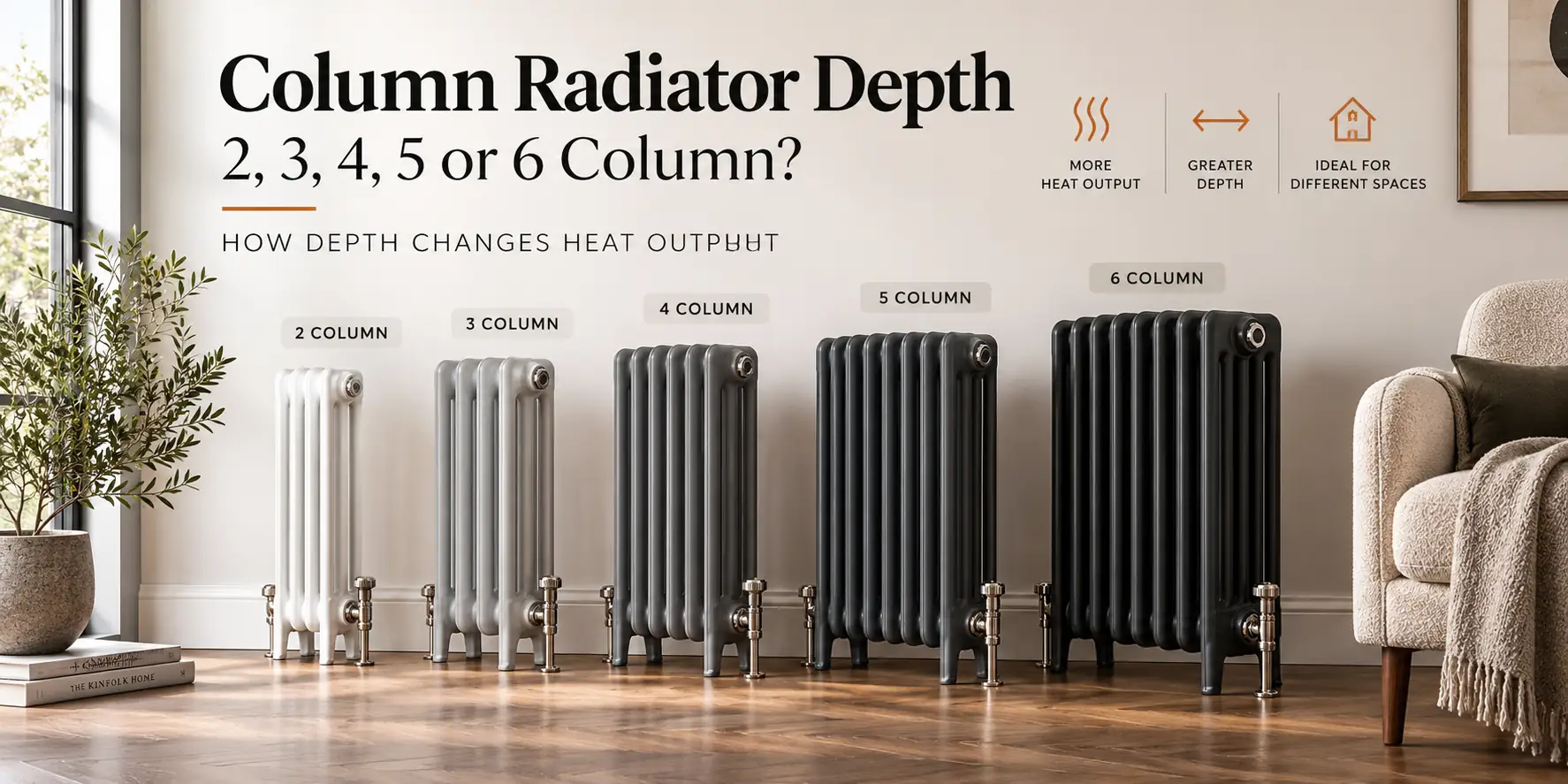
Column radiators are sold by the number of columns, and almost nobody explains what that number buys you. You will see the same radiator listed as two column, three column, four column and upwards, at the identical height and width, for steadily rising prices. The photographs look nearly the same from the front.
The difference is depth, and depth is heat. Adding columns does not make a radiator any wider or any taller. It makes it project further into the room, and it gives you substantially more output from exactly the same piece of wall.
What a Column Actually Is
A column radiator is built from repeated vertical sections, each one a set of tubes joined top and bottom. Look at one from the side and you can count the tubes. Two tubes front to back is a two column radiator. Six tubes front to back is a six column.
Each tube carries hot water and each tube has a surface that gives heat to the room. So a six column radiator has three times the heated surface of a two column one occupying the same footprint on your wall. That is the whole idea, and it is why column radiators survived from Victorian houses into contemporary ones.
The Same Radiator, Five Depths
Here is a genuine comparison from our own range. Every radiator in this table is 600mm high and 1059mm wide. The only thing that changes is the number of columns.
| Columns | Depth | Heat output | Against 2 column |
|---|---|---|---|
| 2 column | 95mm | 4280 BTU | Baseline |
| 3 column | 130mm | 6009 BTU | 40 percent more |
| 4 column | 160mm | 7834 BTU | 83 percent more |
| 5 column | 200mm | 9512 BTU | 122 percent more |
| 6 column | 230mm | 11190 BTU | 161 percent more |
Two things stand out. The first is how much difference this makes. A six column radiator produces more than two and a half times the heat of a two column one, from wall space you have already committed. If you are short of wall, this is the single most effective lever you have.
The second is how consistent the trade is. Work out the output per millimetre of depth and it barely moves: roughly 45 BTU per millimetre at two column, and roughly 49 at six. Depth converts into heat almost in a straight line, which makes the decision refreshingly simple. You are buying centimetres of room, and you know exactly what each one is worth.
What It Costs You in Floor Space
The honest figure is the one in the depth column, plus the wall bracket. A two column radiator sits about 110mm off the wall once fitted. A six column sits nearer 250mm, which is the depth of a decent bookshelf.
In a living room with a skirting board and a sofa a metre away, nobody notices. In a 900mm hallway where two people pass each other, 250mm is a quarter of the corridor and you will feel it every day. That is the real constraint, not the heat.
Measure the projection against something already in the room. A radiator that sits no further out than the window sill above it reads as part of the wall. One that projects past the sill reads as furniture.


Choosing by Room
Living rooms and dining rooms
Three or four column is the usual answer. These rooms have the highest heat requirement in the house and usually enough wall to accommodate some depth. Four column gives you room to be generous without the radiator becoming the first thing you see.
Hallways and landings
Two column, almost always. Circulation space is precious, people carry things through it, and hallways have a lower comfort target than rooms you sit still in. If a two column will not give you the output, go taller rather than deeper.
Kitchens and utility rooms
Two or three column, and check the depth against your appliance doors. A dishwasher door drops forward into the room and a radiator on the opposite wall can be closer than you think.
Period rooms with high ceilings
This is where five and six column earn their keep. A Victorian room with a 3 metre ceiling has a large volume to heat and often limited usable wall because of chimney breasts, bay windows and picture rails. Deep columns are also the period correct look, because that is what those rooms originally had.
Work out the room's requirement before you choose a depth, not after. If your living room needs 6000 BTU and you have 1 metre of wall at 600mm high, the table above tells you immediately that three column is the answer and two column will leave you cold. Our guide to working out what size radiator you need walks through the calculation.
When More Columns Is the Wrong Answer
Depth is not free, and there are three situations where it is the wrong lever to pull.
- You have height available. Going taller costs you nothing in floor space. If the wall is empty above the radiator, use it before you push the radiator into the room.
- The radiator is in a walkway. Anything in a hallway, beside a door swing or at the foot of the stairs should stay shallow regardless of what the output table says.
- Your system runs cool. Heat pumps and low temperature systems need surface area, and they need it spread out rather than buried. The inner columns of a six column radiator do less work at lower flow temperatures than they do on a hot boiler system, so a wider four column often beats a narrow six.
Weight, Water and Warm Up Time
More columns means more water. A six column radiator holds roughly three times the water of a two column of the same size, and that changes how it behaves as well as how it fixes to the wall.
In use, the extra water content is generally pleasant. The radiator takes longer to come up to temperature when the boiler fires, then keeps giving heat out after it stops. In a living room used steadily through an evening, that evens out the temperature swings noticeably.
In fixing terms, it needs respect. A large six column radiator full of water is heavy enough that a plasterboard stud wall will need noggins or proper heavy duty fixings, and floor standing feet are worth considering rather than hanging all of it off the wall. Check what your wall is made of before you order, because that is much easier than discovering it with a drill.
Frequently Asked Questions
How much more heat does a 3 column radiator give than a 2 column?
About 40 percent more, at the same height and width. On our 600mm by 1059mm radiators the two column gives 4280 BTU and the three column gives 6009 BTU, for an extra 35mm of projection into the room. It is usually the best value step in the whole range.
How deep is a 4 column radiator?
160mm for the radiator body, so around 175mm from the wall once the brackets are accounted for. For comparison, a two column is 95mm and a six column is 230mm. All of them sit comfortably behind a standard window sill.
Is a 6 column radiator worth the extra cost?
It is worth it when wall space is your limiting factor rather than budget. If you physically cannot fit a wider or taller radiator and the room is still cold, six column is how you get 11000 BTU from a single metre of wall. If you have spare wall, a wider four column will usually cost less for the same output.
Do more columns make a radiator less efficient?
No. Output per millimetre of depth stays almost constant across the range, so you get what you pay for in space. The one caveat is low temperature systems such as heat pumps, where spreading the surface area out works better than stacking it deep.
Getting the Depth Right
Start with the output the room needs, then measure the wall you have, and let the two numbers choose the column count for you. Depth is the lever you use when width and height have run out, and it is a genuinely powerful one.
Browse the full range of column radiators, or have one built to your exact size in any of the five depths. If a room is stubbornly cold and you have run out of wall, our high heat output radiators are the place to look. Call 01204 695387 with your wall measurement and we will tell you what output you can get out of it.
0 Comment(s)